

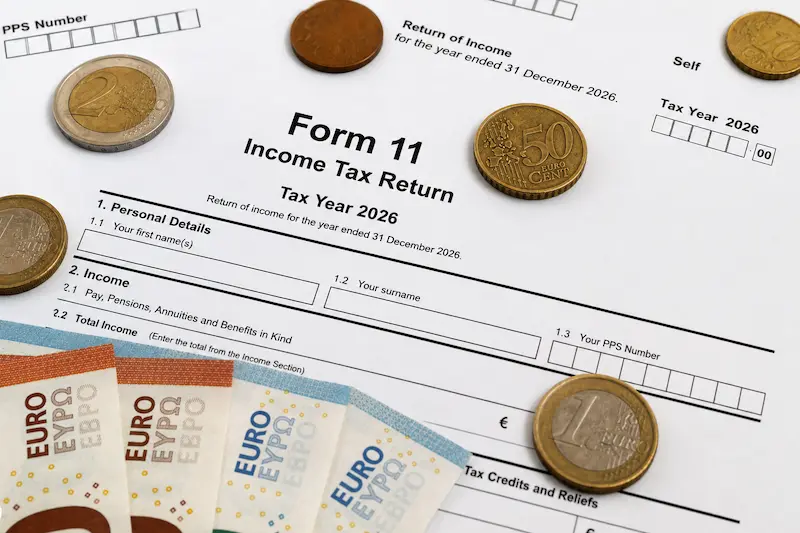
Who needs to file a Form 11 in Ireland is where tax can start to feel complicated, particularly when PAYE income, freelance work, rental income or other earnings all need to be brought together.
But the first question is relatively simple: do Revenue’s self-assessment rules apply to you?
Self-employed people, proprietary company directors and people with significant non-PAYE income are among those most likely to need Form 11. For PAYE workers with additional income, two Revenue thresholds are particularly important: €5,000 in taxable non-PAYE income and €30,000 in gross non-PAYE income.
Here’s the clearest way to work out where you stand!
What is a Form 11?
Form 11 is the annual Income Tax Return used by people within Ireland’s self-assessment system. Most people submitting one do so through the Revenue Online Service (ROS).
Revenue uses the term “chargeable person” for someone who comes within full self-assessment.
Importantly, earning some income outside PAYE does not automatically mean you need to file Form 11. Certain PAYE taxpayers with smaller amounts of non-PAYE income can instead declare it through the PAYE system.

Who needs to file a Form 11 in Ireland?
You will generally need to consider Form 11 if you:
- Are self-employed
- Are a sole trader, freelancer, contractor or consultant
- Are a proprietary company director
- Have significant rental income
- Receive investment, foreign or other non-PAYE income
- Have multiple sources of income that bring you within Revenue’s self-assessment rules
For PAYE taxpayers with additional income, the thresholds are an important starting point.
Who needs to file a Form 11: The income thresholds that matter
Revenue says you must register for self-assessment where your:
- Taxable non-PAYE income exceeds €5,000, or
- Gross non-PAYE income exceeds €30,000
Taxable non-PAYE income is the amount subject to tax after relevant deductions.
Gross non-PAYE income is the amount received before those deductions.
For example, a PAYE employee with €7,000 in taxable freelance profit would exceed the taxable-income threshold. Someone with €35,000 in gross non-PAYE income could also come within self-assessment even if deductions reduce their taxable profit below €5,000.
Self-employed people, sole traders and freelancers
Revenue says self-employed people should register for Income Tax self-assessment. This includes many sole traders, freelancers, consultants and independent contractors.
Having a PAYE job alongside self-employed work does not automatically remove this obligation. Your overall income and circumstances still need to be considered.
And this is often where the real friction starts. Income may be coming from several places, expenses need to be accounted for, and information can be scattered across different records.
The challenge is not always knowing that Form 11 exists. It is bringing everything together and knowing nothing relevant has been missed.
Landlords and rental income
Rental income is another common reason people enter self-assessment.
For PAYE workers with rental income on the side, however, the amount matters. A smaller amount of rental profit does not automatically mean Form 11 is required; Revenue’s non-PAYE thresholds and PAYE collection rules also need to be considered.
Investment, foreign and other non-PAYE income
Investment income, foreign income including foreign pensions, and certain other non-PAYE earnings can also affect whether you need to enter self-assessment.
If you have several additional income sources, look at the overall picture rather than considering each one in isolation.
Who needs to file a Form 11 even if they pay PAYE?
Company directors
A particularly important distinction is between proprietary and non-proprietary directors.
Revenue defines a proprietary director as someone who is the beneficial owner of, or can directly or indirectly control, more than 15% of the ordinary share capital of a company.
Proprietary directors are chargeable persons and are required to complete Form 11, even where PAYE is operated on their salary. Revenue also states that the jointly assessed spouse or civil partner of a proprietary director must submit Form 11.
A non-proprietary director who pays all of their tax through PAYE does not automatically have the same requirement. They may still need Form 11 for another reason, such as significant non-PAYE income.
What if you pay PAYE but have other income?
PAYE deductions from your salary do not necessarily mean all of your tax affairs are dealt with through payroll.
Freelance work, consulting, rental income, investments or other additional earnings can all affect your filing position.
Revenue’s general guidance says a PAYE taxpayer with taxable non-PAYE income of €5,000 or less, where gross non-PAYE income is €30,000 or less, may be able to declare that income through the PAYE Income Tax Return where the tax is collected by adjusting tax credits and rate bands.
That is why having non-PAYE income and needing Form 11 are not always the same thing.
Form 11 vs Form 12
The simplest distinction is:
- Form 11 is generally for chargeable persons within full self-assessment and is usually submitted through ROS.
- Form 12, submitted online, is used by PAYE taxpayers outside full self-assessment, including certain people with smaller amounts of non-PAYE income.
If you are unsure which applies, start with Revenue’s self-assessment rules and the €5,000 / €30,000 thresholds.
When is Form 11 due?
The standard Pay and File deadline is 31st October in the year following the relevant tax year.
For the 2025 Form 11 being filed in 2026, the standard deadline is 31st October 2026. Revenue has extended this to 18th November 2026 for qualifying taxpayers who both file their return and make the appropriate payment through ROS.
Late filing can result in a surcharge. Revenue currently applies:
- 5% of the tax due, up to €12,695, where the return is less than two months late
- 10% of the tax due, up to €63,485, where the return is more than two months late
If a deadline has already passed, leaving it on the long finger usually does not make the situation easier. The useful next step is to establish what needs to be filed, get the information organised and start working through it.

A smoother way to file your Form 11 with Tax Return Pro
Knowing you need Form 11 is one thing. Pulling together income, expenses and other information, working out what Revenue needs and getting everything filed correctly is often the part people keep putting off.
At Tax Return Pro, we provide a more digital way to get it done.
Our online Form 11 Tax Return service gives you a structured interface between you and Revenue. Instead of relying on scattered paperwork, long email chains or repeated back-and-forth, you work through a guided online process designed to bring the information together clearly.
Technology makes that process easier, but it does not replace professional judgement. Every return is manually reviewed by experienced tax professionals before it is filed.
Our process is designed to reduce friction from start to finish:
- Complete a clear, step-by-step online questionnaire
- Bring your relevant tax information together through one structured process
- Have your return prepared and manually reviewed by experienced tax professionals
- Review and approve the return before anything is submitted
- Have Tax Return Pro file with Revenue on your behalf
- Get support with Revenue queries where required
If Form 11 has been sitting on your to-do list, the easiest way forward is to start.
Get in touch or visit our Form 11 Tax Return service and work through the process step by step.