


Overpaid PAYE Tax can still happen even though tax is deducted automatically from your wages.
A job change, Emergency Tax, a period out of work, unclaimed medical expenses or unused tax credits could all mean you have paid more Income Tax or Universal Social Charge (USC) than you ultimately owed.
That does not mean a refund is guaranteed. A tax review can also uncover an underpayment. But if any of the seven situations below apply to you, your PAYE position may be worth checking.
What does overpaid PAYE tax mean?
Under PAYE, your employer deducts Income Tax and USC from your salary based on the information available through Revenue.
Your final position depends on your total income, tax credits, reliefs and other relevant circumstances for the year. If too much has been deducted, you may be due a tax refund. If too little has been deducted, a review may instead reveal an underpayment.
The important question is therefore not simply whether tax was deducted from your wages, but whether the correct amount was deducted across the year.
How overpaid PAYE tax can happen under the PAYE system
An overpayment can arise where, for example, Emergency Tax was applied, your employment circumstances changed, or a credit or relief you were entitled to was not claimed.
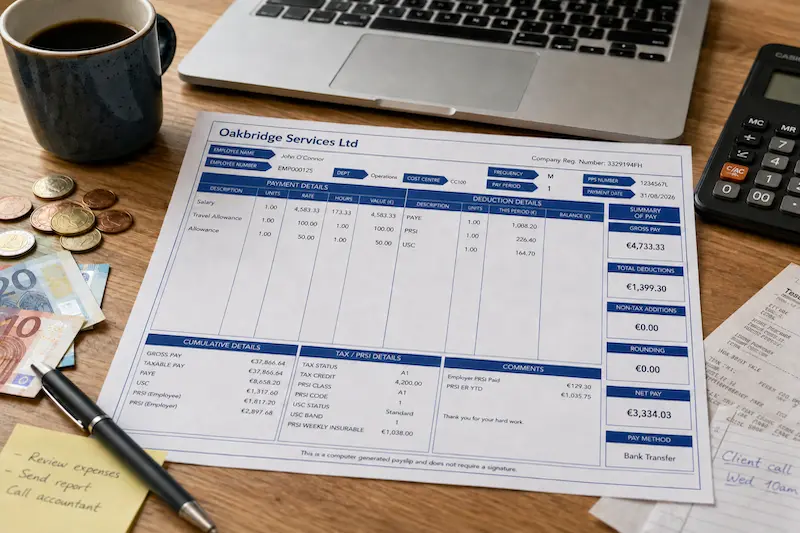
Your payslip shows deductions for a particular pay period. To assess the year as a whole, check your Revenue record. Revenue’s Preliminary End of Year Statement (PEOYS) can indicate whether your position is potentially overpaid, underpaid or balanced. The position is finalised after you complete the relevant PAYE Income Tax Return and receive your Statement of Liability.

7 signs you may have overpaid PAYE tax
#1. Your Revenue record shows a potential overpayment
One of the clearest signs is a PEOYS showing a potential overpayment.
Revenue uses this statement to indicate whether your Income Tax and USC position appears to be overpaid, underpaid or balanced.
Treat the figure as a starting point rather than a guaranteed refund. Missing income, tax credits or reliefs may still need to be added before your final position is confirmed.
#2. You paid Emergency Tax
Emergency Tax can mean that too much tax was temporarily deducted from your wages.
It can apply where your employer does not yet have the correct Revenue Payroll Notification (RPN), for example because your PPSN has not been provided or your employment has not been correctly registered.
Once the correct cumulative information becomes available, an overpayment may be corrected through payroll or through a later tax review.
#3. You changed jobs during the year
Changing jobs can affect how your tax credits and rate bands are applied, particularly where an old employment has not been properly ceased, or your new employer does not yet have the correct RPN.
Revenue states that a new employer may be able to repay overpaid Income Tax and USC once it receives a cumulative RPN.
If you changed jobs during the year, it is therefore worth checking that your employment record and tax position were updated correctly.
#4. You had two or more jobs at the same time
Having more than one job does not automatically mean that you have overpaid tax.
However, it can make your PAYE position more complicated because your tax credits and rate bands may need to be divided between employments.
The total amount of tax ultimately due does not change simply because you have two jobs, but the way deductions are applied during the year can affect what comes out of each payslip.
#5. You stopped working or were unemployed for part of the year
If you worked for part of the year and then stopped, you may have paid more Income Tax or USC than was ultimately due.
Revenue provides for unemployment repayments in certain circumstances, depending on factors such as whether you have other taxable income.
People who worked in Ireland for part of a year before moving abroad may also have a PAYE position worth reviewing.
#6. You paid qualifying expenses but never claimed the available tax relief
Some PAYE taxpayers pay more tax than necessary simply because they never claimed relief for eligible expenses.
Examples can include:
- Qualifying medical expenses
- Eligible remote working costs
- Other expenses for which Revenue provides a specific tax relief
Revenue allows qualifying health expense claims for the previous four years where the conditions are met, and the required receipts are available.
Eligible remote workers may also be able to claim relief on qualifying electricity, heating and broadband costs.
#7. You were entitled to a Tax Credit or Employment Expense you never claimed
Unused tax credits and employment-related allowances can also affect your final tax liability.
Depending on your circumstances, this could include:
- The Rent Tax Credit
- Flat Rate Expenses for certain occupations
- Other tax credits or reliefs that were not applied during the year
Revenue describes Flat Rate Expenses as allowances covering qualifying employment costs such as tools, uniforms and statutory registration fees.
The Rent Tax Credit can reduce the Income Tax due for eligible renters.
One missed relief may seem small, but a PAYE review can involve several different pieces of information (such as employment changes, expenses, credits and Revenue records) that need to be looked at together.
How to check whether you have overpaid PAYE tax
Review your PAYE information
Your PAYE position should be reviewed across the relevant tax year, including your employment details, pay and tax information, and Preliminary End of Year Statement (PEOYS). We can help bring this information together and identify anything that may need a closer look.
Check your credits, reliefs and additional income
Check whether all relevant credits and reliefs have been included. You should also declare any additional taxable income that Revenue requires you to report. A tax review is intended to establish the correct position, not simply to produce a refund.
Complete your PAYE Income Tax Return and review your Statement of Liability
After submitting your PAYE Income Tax Return, Revenue issues a Statement of Liability confirming whether you have overpaid, underpaid or balanced your Income Tax and USC position.
Revenue says the Statement of Liability is normally available approximately five working days after completing the return.
How far back can you correct overpaid PAYE tax?
Revenue applies a four-year time limit to PAYE refund claims, allowing you to review your tax for the previous four years.
That means, for example, a refund claim relating to the 2022 tax year generally needs to be made by 31 December 2026. Waiting too long could mean losing the opportunity to claim a refund that would otherwise have been available under the four-year rule.
Common misunderstandings about overpaid PAYE tax
Emergency Tax does not always mean waiting until the end of the year. Once an employer receives a cumulative RPN, an in-year payroll correction may be possible.
Week 1 basis is also different from Emergency Tax. Under Week 1, your tax credits and rate bands are not backdated or accumulated in the normal cumulative way. Revenue states that an employer cannot make a refund that may be due until a cumulative instruction is available.
Similarly, having a second job does not itself prove that you have overpaid. And importantly, a year-end review can uncover an underpayment as well as a refund.

Think you’ve overpaid PAYE tax? Tax Return Pro can help!
You may have changed jobs, worked from home, paid medical expenses and missed a tax credit all in the same year.
The difficult part is often not identifying one possible reason for a refund; it’s pulling together the different pieces of your tax position and working out whether Revenue actually owes you money.
At Tax Return Pro, we provide PAYE employees with a more frictionless way to check.
Our Tax Refund service uses a guided online process designed to capture the information relevant to your circumstances, assess potential refund opportunities and prepare a claim for submission to Revenue where appropriate.
Technology makes that process easier, but it does not replace professional judgement. Every application is manually reviewed by experienced tax professionals, and in the unlikely event that your review identifies a tax liability rather than a refund, you’re not left to deal with it alone. We’ll help you understand the position and assist you in correcting it with Revenue.
Our process includes:
- A guided online process in plain English
- Review of relevant employment changes, tax credits, reliefs and expenses
- Your information organised through one structured digital process
- Manual review by experienced tax professionals
- Submission to Revenue where a refund claim is appropriate
- No Refund, No Fee: you only pay if a rebate is successfully claimed
If you’ve been wondering whether you have overpaid PAYE tax, don’t leave it sitting on the to-do list. Visit our PAYE Tax Refund service to find out where you actually stand!